'Scary' Tariffs Swing Wildly, Plaguing US Restaurants and Producers

Ranging from European wines to industrial equipment, the worldwide tariffs implemented by U.S. President Donald Trump this week aim to affect the nation’s largest economic sector, influencing stakeholders such as restaurateurs and manufacturing companies alike.
For Brett Gitter, who makes his quality control instruments in China-based factories, Trump's planned tariff hike on goods from the country marks a further price surge to potentially startling levels for customers.
"I add a surcharge at the bottom of every invoice to cover the expense of the tariff," he told AFP.
"At the bottom of the invoice, you will see 54 percent," he mentioned, pointing out a new tariff that will affect Chinese goods beginning next Wednesday.
Everything adds up to an additional 25 percent tariff on top of the rates that were previously imposed on Chinese goods when Trump was president, he explained, even though efforts were made to offset some of those initial tariffs.
He remarked, 'That’s quite significant.' He also noted, ‘It might worry people.’
This week, Trump announced a broad 10 percent tariff on the majority of U.S. trading partners, scheduled to come into force on Saturday.
He announced that foreign trade policies have led to a "national crisis," implementing tariffs to strengthen his nation's standing.
Additionally, "worst offenders" that have large trade imbalances with the United States will face even higher rates come April 9.
The list covers about 60 partners including the European Union, China, India and Japan.
Gitter said his customers, who are American manufacturers too, will have to decide if they want to foot the higher bill.
He mentioned that other nations with comparable products have also imposed tariffs.
How does my Chinese-made product fit into the market, and how significantly does it get impacted compared to other rivals?
'Frightening'
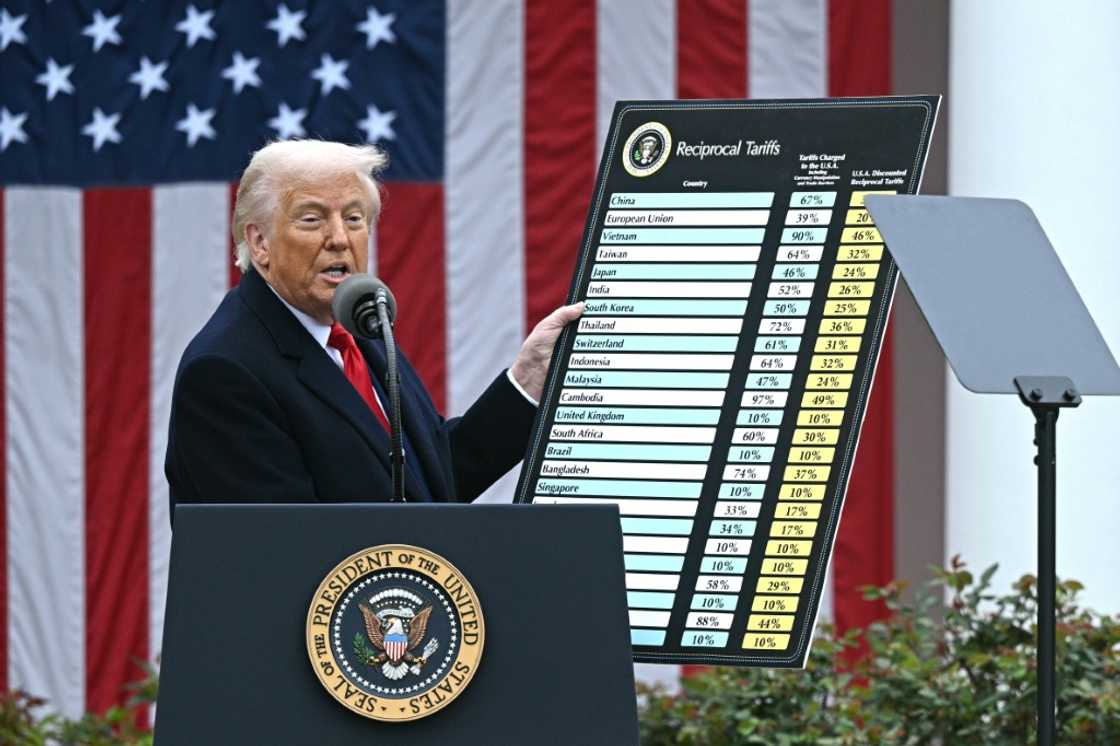
Andrew Fortagan, who operates three restaurants and a wine shop in Oregon, expresses concern over President Trump’s extra 20 percent tax on goods from the European Union, particularly concerning his business with wine.
The rate will also come into effect on April 9.
"Probably 25 percent of our revenue is from imported wine," he told AFP, noting that the steep tariff will bite.
These sales disappearing would be 'quite alarming,' he stated.
Beyond that, everything ranging from oils, to mustards, cheeses, and meats—they are simply not interchangeable, they are not produced locally,” Fortgang stated. “The costs will accumulate.”
Although he anticipates that he might need to increase menu prices to offset some of the costs, high inflation following the Covid-19 pandemic has put pressure on customers.
He mentioned that you might hit a threshold at some point regarding how far you can increase prices.
The US Wine Trade Alliance president, Ben Aneff, described the proposal as "catastrophic for small enterprises."
"He mentioned that restaurants heavily depend on substantial profit margins to support other aspects of their operations." He also noted that this could lead to increased costs for consumers.
"We import approximately $4.5 billion worth of wine from the EU, and U.S. companies generate nearly $25 billion from these imports. This gap cannot be easily filled," he stated to AFP.
Other companies within the food and beverage industry have already felt the impact of Trump's successive rounds of tariffs.
Bill Butcher, a craft brewer based in Virginia, previously encountered a bottleneck in glass bottle supplies for his beers after metal tariffs were implemented in March—since major corporations shifted their focus away from aluminum cans to circumvent additional expenses.
Currently, he is waiting for the suppliers' decision on how much the upcoming tariffs on European products will increase the expenses for the grains and hops required in his beers.
"It's just a lot of uncertainty and chaos in our supply chain," he said.
Hard to relocate
Gitter, whose business is based in New Jersey, has tried "many times" to relocate production to the United States.
"There's a lack of infrastructure in the US to support what we do," he said.
The printed circuit boards used in his instruments, for example, require chips made in East Asia.
Will Thomas, whose company transforms coils of steel into metal products, added: "We import from necessity, not desire."
While he is not hard hit by Trump's partner-based tariffs this week, earlier 25 percent duties on steel and aluminum imports have eaten away at his profits.
"I’m hopeful this isn’t just another strike against foreign suppliers,” Thomas stated.
I simply wish for the nation's leaders to convene and resolve issues through discussion.
Komentar
Posting Komentar